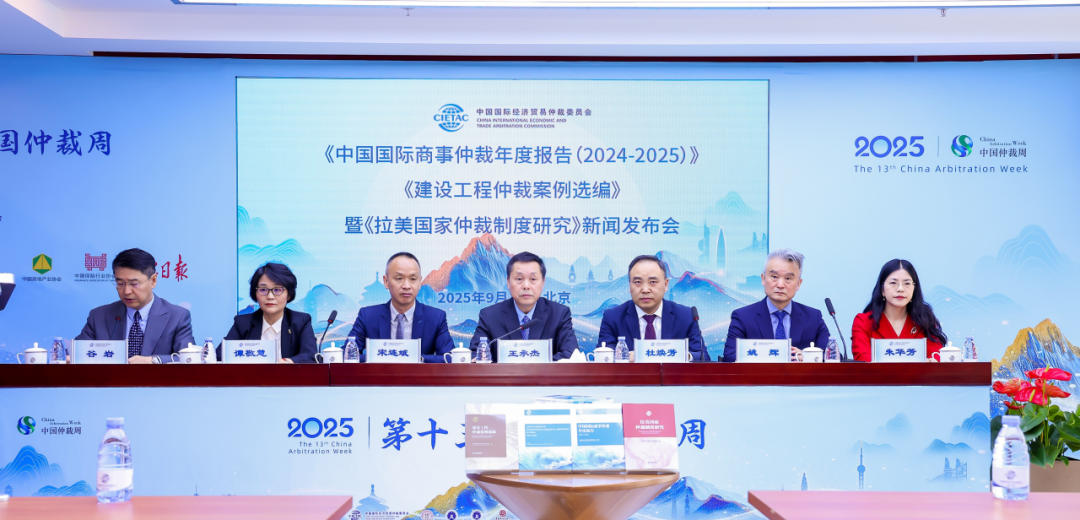
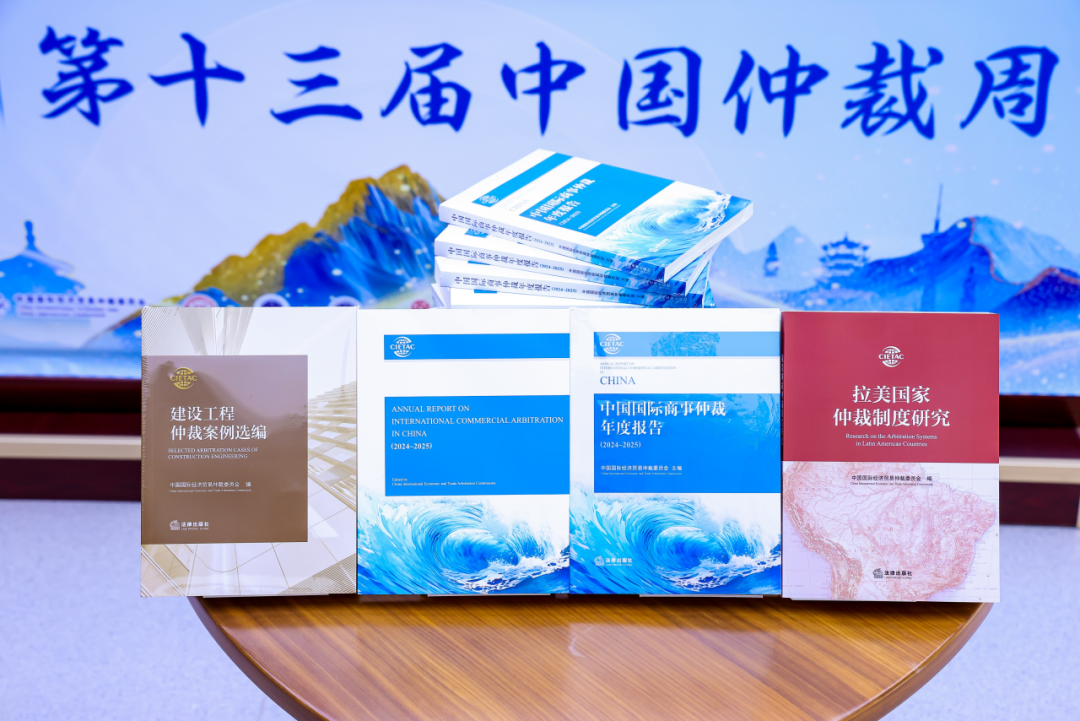
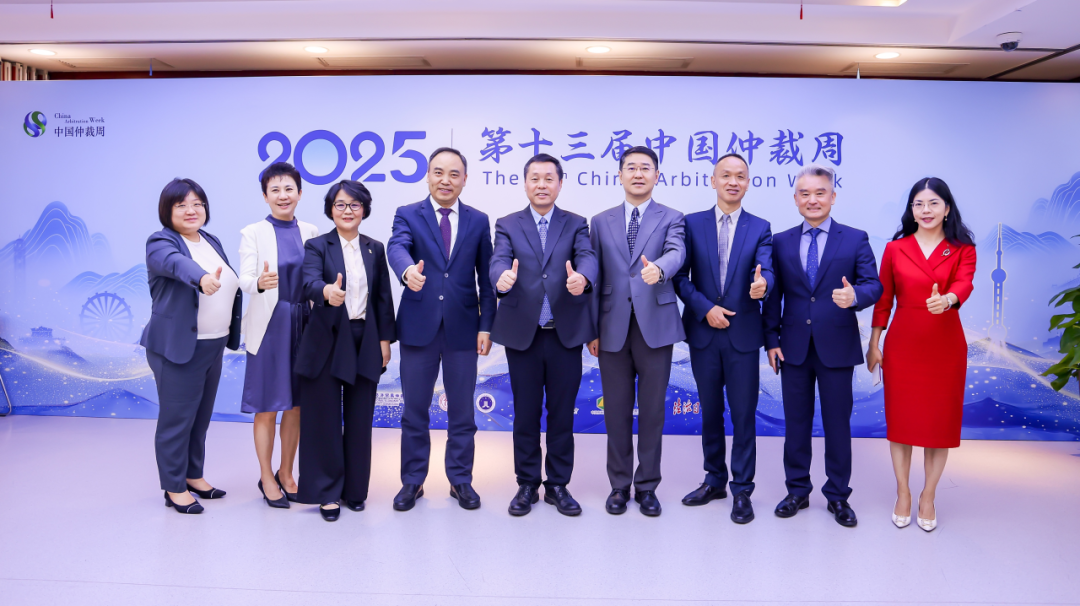
On September 16, 2025, China International Economic and Trade Arbitration Commission ("CIETAC" for short) held a press conference in Beijing. Wang Chengjie, Vice Chairman and Secretary General of CIETAC, released the Annual Report on China's International Commercial Arbitration (2024-2025) ("2024-2025 Annual Report"), Selected Arbitration Cases on Construction Engineering ("Selected Construction Engineering Cases") and Study on Arbitration Systems of Latin American Countries ("Latin America Study") at the conference. Gu Yan, Vice President of CIETAC Arbitration Court, presided over the press conference.


Secretary General Wang Chengjie pointed out that to implement the policy on better fostering a number of world-class arbitration institutions and building China into a new global destination for international commercial arbitration, CIETAC decided to continue compiling and releasing the 2024-2025 Annual Report based on 10 years of experience. It also selected and studied typical cases from the construction engineering arbitration cases, which have been the largest in number accepted by CIETAC in recent years, to compile the Selected Construction Engineering Cases. In addition, with the gradual rise of the "Global South" and the continuous expansion of economic and trade exchanges between China and Latin America under the framework of the Belt and Road Initiative, CIETAC conducted research and compiled the Latin America Study based on its previous research on arbitration systems of countries along the Belt and Road. The purpose of the study is to further promote the improvement of China's arbitration system, industry development and information exchange, and enhance China's credibility and influence in the international commercial arbitration arena.


At the press conference, Secretary General Wang Chengjie introduced the contents and highlights of the 2024-2025 Annual Report, the Selected Construction Engineering Cases and the Latin America Study respectively. The 2024-2025 Annual Report was commissioned by CIETAC to a research team formed by Renmin University of China, whose core members include experts and practitioners from the Supreme People's Court, the Ministry of Justice, institutions of higher education, enterprises and law firms. Based on a comprehensive analysis of the data of China's international commercial arbitration cases in 2024, the 2024-2025 Annual Report simultaneously tracks the latest developments in the construction of China's international commercial arbitration centers, international exchanges in commercial arbitration, and theoretical research on commercial arbitration at home and abroad, and continuously explores the key issues in the judicial review of China's international commercial arbitration. The report also comprehensively stuties the application of the PRC Civil Code in the arbitration field since its promulgation five years ago, makes a comparative analysis of the practices of different arbitration institutions regarding complex arbitrations procedures such as multi-contract arbitration, joinder of parties, and consolidated arbitration, and focuses on the hot issues in construction engineering disputes, which accounted for the most significant share of cases accepted by arbitration institutions in recent years. To support this key research, CIETAC specially organized the compilation of the Selected Construction Engineering Cases, which includes 15 representative real cases of CIETAC, with analytical comments written by arbitrators.

The Latin America Study is the first research in China focusing on the national arbitration systems in Latin America. The research team is led by Professor Song Lianbin from School of International Law, China University of Political Science and Law, and its core members include scholars, lawyers and in-house counsel from China and Latin American countries. Adopting a combination of comparative law, empirical law and case study methods, the research team comprehensively sorted out the arbitration legislation, institutional settings, procedural mechanisms and other aspects of representative countries and regions with different legal systems in Latin America, such as Argentina, Brazil, Mexico, Colombia, etc. It focused on analyzing the similarities and differences of arbitration legal systems among various countries in terms of arbitrability, jurisdiction, interim measures, recognition and enforcement of awards, and in-depth discussed the interactive integration and local application of Latin American arbitration systems with international rules such as the New York Convention and the Washington Convention.

The 2024-2025 Annual Report, the Selected Construction Engineering Cases and the Latin America Study demonstrate the remarkable achievements of China's arbitration in the past year, and provide useful references for Chinese and foreign economic entities to better understand, recognize and participate in China's arbitration.


Secretary General Wang Chengjie stated that the research of the above three projects shows that arbitration, as an internationally accepted method for resolving economic and trade investment disputes, has become an important means for countries to optimize the business environment and enhance the rule of law. At a time when countries around the world are paying more attention to the development of arbitration and international competition is becoming increasingly fierce, Chinese arbitration institutions represented by CIETAC have made continuous achievements in the process of internationalization and professionalization, and the international credibility and global influence of China's arbitration are constantly rising. CIETAC will continue to comply with the requirements of coordinating the advancement of domestic rule of law and foreign-related rule of law, thoroughly implement the new development concept, and proactively serve the new development pattern. With the goal of building a benchmark of world-class arbitration institutions with more sound systems, more precise management and more thoughtful services, CIETAC will vigorously promote the digitalization, intelligence and informatization of arbitration, continuously improve arbitration credibility, and show new achievements and responsibilities at a new starting point.


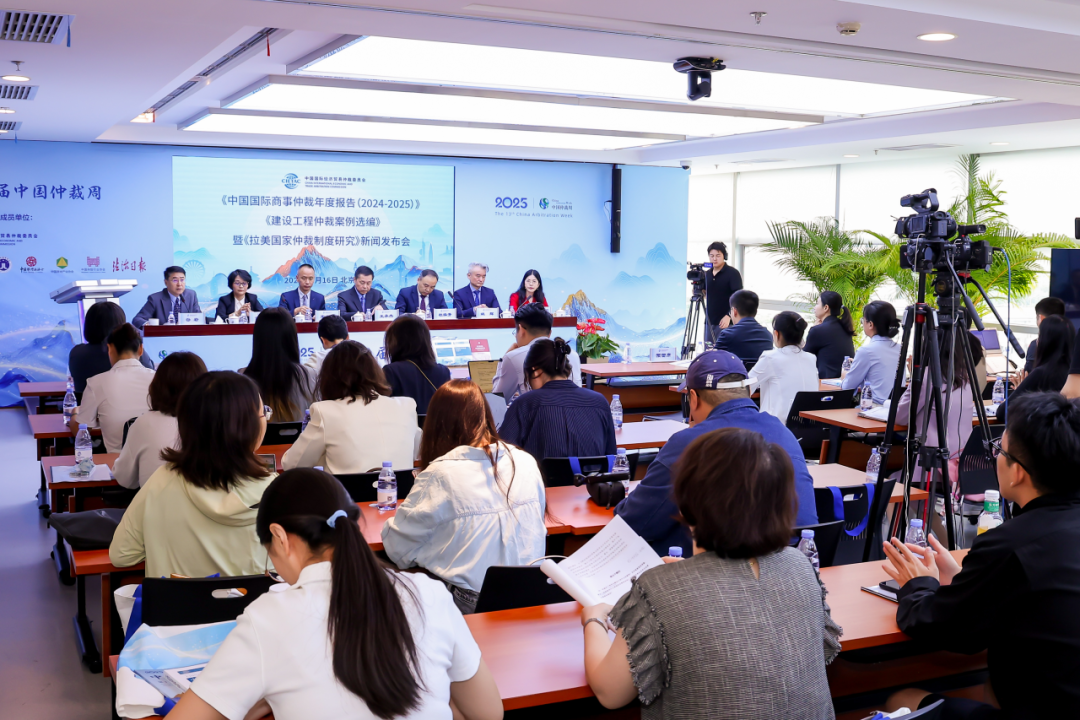
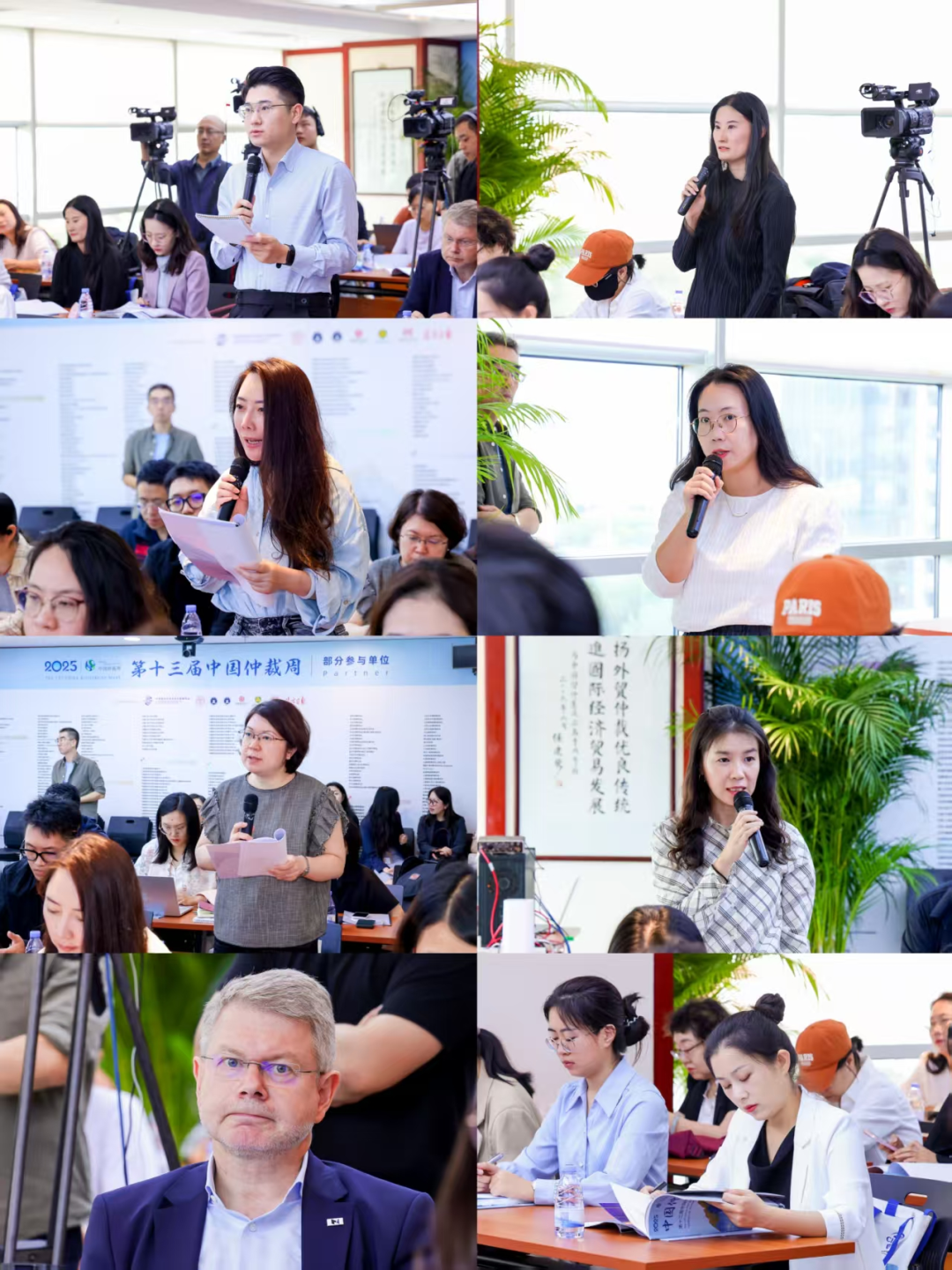
Thirty news media outlets including Xinhua News Agency, China Central Television, China News Service, China Reform Daily, China Youth Daily, Legal Daily, Economic Daily, China Trade News, International Business Daily and Phoenix Satellite TV attended the press conference on site, and the live broadcast of the conference  was watched nearly 1,700 times online. Professor Du Huanfang, Dean of the Institute of Foreign-related Rule of Law of Renmin University of China, Professor Yao Hui, Director of the Civil and Commercial Law Research Center of Renmin University of China, Zhu Huafang, Partner of Beijing Huizhong Law Firm, Tan Jinghui, Founding Partner of Beijing Jundu Law Firm (all are core members of the 2024-2025 Annual Report research team), and Professor Song Lianbin, Head of the “Latin America Research” Project and from the School of International Law of China University of Political Science and Law, answered questions from the media regarding relevant issues.


{{ article.quickLinkTitle ? article.quickLinkTitle : 'Quick Links' }}
Quick Links