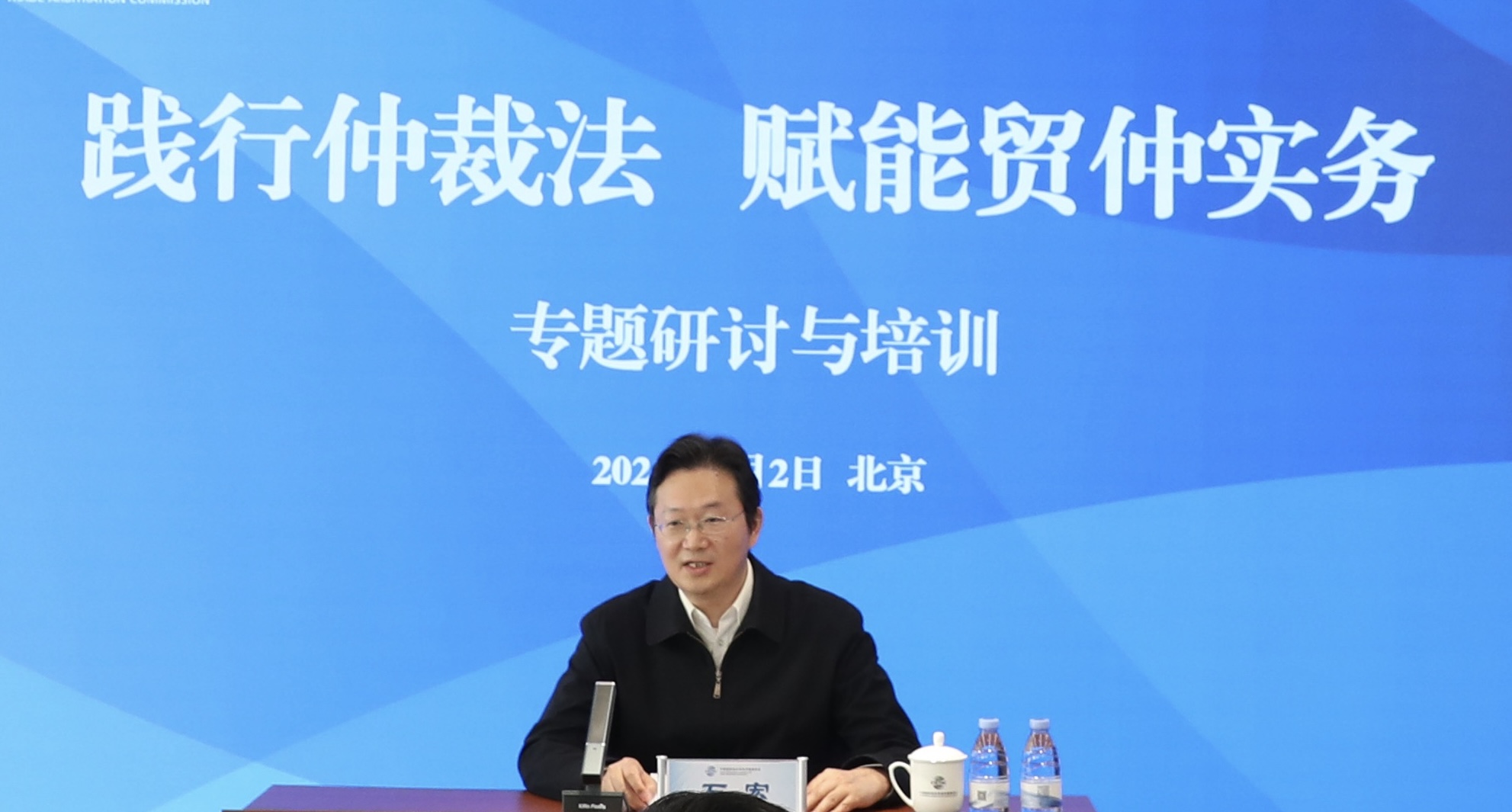
On the afternoon of February 2, 2026, the China International Economic and Trade Arbitration Commission (CIETAC) successfully held a seminar in Beijing titled "Implementing the Arbitration Law to Empower CIETAC Practice." The newly revised Arbitration Law of the People's Republic of China  is coming into effect on March 1. Representing the most comprehensive and profound reform of China’s arbitration system in three decades, this revision also serves as a key legislative measure to strengthen the rule of law in foreign-related matters and facilitate high-standard opening up . It signals a new phase in the nation's arbitration development, wherein institutional openness drives high-quality development . In order to assist arbitrators and institutional staff in accurately grasping the essence of the new law and comprehensively enhancing their professional capabilities under this updated legal framework, CIETAC organized this seminar. The seminar was honored by the presence of Nie Wenhui, Vice Chairman of China Council for the Promotion of International Trade (CCPIT) . Meanwhile, Shi Hong, Director of the Civil Law Office of the Legislative Affairs Commission  of the Standing Committee of the National People's Congress , delivered an authoritative interpretation of the legislative spirit and core principles of the new Arbitration Law. Wang Chengjie, Vice Chairman and Secretary-General of CIETAC, gave opening remarks, while Xie Changqing, Vice President of the Arbitration Court of CIETAC , provided concluding remarks. The seminar was chaired by Gu Yan, Vice President of CIETAC Arbitration Court . Directors of relevant CIETAC departments presented specialized briefings on harmonizing the new Arbitration Law with the CIETAC Arbitration Rules, in addition to key issues concerning the judicial review of arbitral awards. The seminar drew an enthusiastic response and broad participation from CIETAC arbitrators and staff, attracting over 370 attendees, of whom more than 230 were arbitrators.


(The seminar at CIETAC)


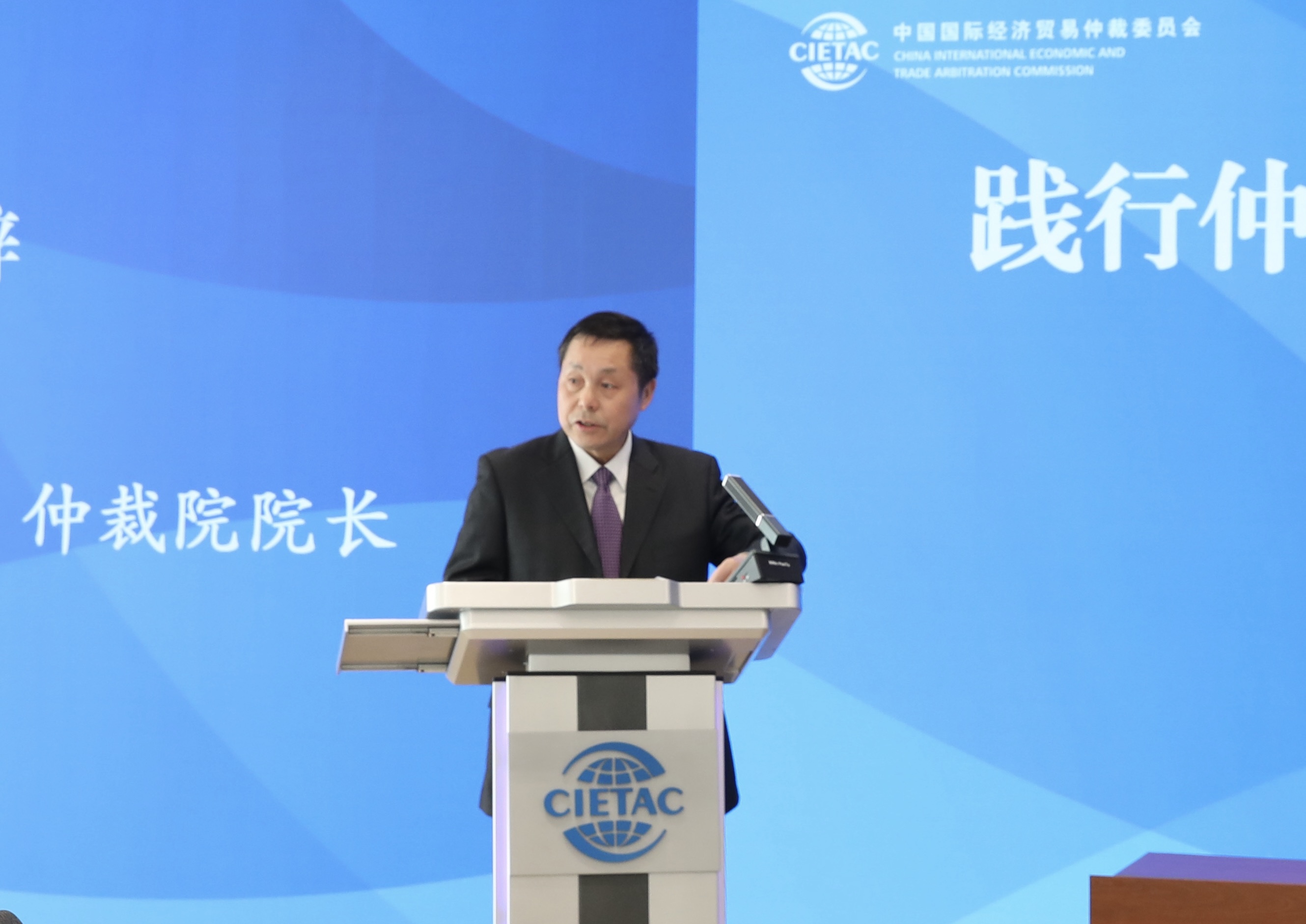
Wang Chengjie, Vice Chairman and Secretary-General of CIETAC, delivered the opening remarks. He said that the newly revised Arbitration Law represents a significant refinement of China's arbitration system over the past three decades and stands as a key legislative achievement in implementing the decisions and plans of the Central Committee of the Communist Party of China (CPC)  concerning arbitration. At this pivotal moment as the new Arbitration Law is about to take effect, CIETAC's organization of this seminar constitutes both a concrete action to implement the legislative revision and an inherent requirement for enhancing the quality and efficiency of arbitration, carrying substantial importance. He pointed out that as first foreign-related arbitration institution in China, CIETAC has maintained deep connections and evolved in step with the legislative, revision, and implementation processes of China's Arbitration Law throughout its 70-year history, contributing its expertise once again to this latest revision. He briefly reviewed that over the past year, focusing on its strategic goal of becoming a world-class arbitration institution, CIETAC achieved record-high arbitration caseloads. Milestone progress was made in refining the arbitration service system, enhancing the capabilities of the arbitration team, and establishing digital governance frameworks. Breakthrough accomplishments were also realized by CIETAC in participating in global governance and continuously enhancing the credibility and international influence of arbitration. He stressed that the implementation of the newly revised Arbitration Law marks a new phase of high-quality development  for China's arbitration sector and presents fresh opportunities for CIETAC's work. Studying and implementing the new Arbitration Law is a critical task for CIETAC and the entire arbitration industry in the current and future periods. CIETAC will focus its efforts on three key areas: advancing tiered training for all personnel, ensuring precise alignment with the new rules, and strengthening oversight mechanisms. He urged all CIETAC arbitrators and staff to seize this training opportunity, attentively listen to the lectures, engage in in-depth discussions, and effectively translate learning outcomes into concrete actions in fulfilling their duties; strictly adhere to the provisions of the new law, uphold professional competence and ethical standards, and fulfill their mission and responsibilities by delivering standardized, professional, impartial, and efficient arbitration services. All CIETAC arbitrators and staff shall advance the sustained and healthy development of China's arbitration sector, making new and greater contributions to serving the nation's high-standard opening up  and high-quality economic development .


(Wang Chengjie, Vice Chairman and Secretary-General of CIETAC, delivers the opening remarks.)


Shi Hong, Director of the Civil Law Office of the Legislative Affairs Commission  of the Standing Committee of the National People's Congress , delivered a lecture on the newly revised Arbitration Law. He systematically elaborated on the background, overall approach, and core content of this revision. He emphasized that this revision is a major legal revision and systematic innovation built upon thirty years of practical experience with China's Arbitration Law. It holds profound significance for improving China's arbitration legal system, enhancing the credibility of arbitration, and promoting high-quality development. He stated that this revision fully implements the decisions and plans of the Central Committee of CPC , adopts a problem-oriented approach, addresses prominent issues in arbitration practice based on China's national conditions, and strives to break through bottlenecks hindering the development of arbitration. It serves as a crucial legal safeguard for advancing the rule of law in foreign-related matters and supporting the country's high-level opening up. Regarding the fundamental principles of the revision, Shi Hong explained that the new Arbitration Law preserves the distinctive features and advantages of the arbitration system, adheres to the principle of arbitration independence, and clarifies the overall requirements for the development of arbitration. Regarding its core content, the new law focuses on improving legal systems related to foreign-related arbitration , ad hoc arbitration , international investment arbitration, governance of arbitration institutions, and arbitrator qualifications. It introduces the concept of the seat of arbitration, strengthens judicial support and supervision mechanisms, and establishes an arbitration legal system aligned with international rules. At the legislative level, it supports arbitration institutions in enhancing international cooperation and exchanges, encouraging them to "go global" and "bring in"  international resources. This is significant for effectively enhancing the international competitiveness of China's arbitration institutions and establishing China as a preferred seat for international commercial arbitration. Shi Hong emphasized that the vitality and authority of law lie in its implementation. He advocated that arbitrators and arbitration institution staff thoroughly study and understand the new Arbitration Law, transforming institutional innovations into practical capabilities. This will ensure the new law moves from "paper" to "practice", injecting momentum into advancing the high-quality development of China's arbitration sector, supporting the nation's high-standard opening up , and promoting high-quality rule of law construction. 


(Shi Hong, Director of the Civil Law Office of the Legislative Affairs Commission  of the Standing Committee of the National People's Congress, delivered a keynote lecture.) 


Focusing on the theme of "Aligning the New Arbitration Law with the CIETAC Arbitration Rules," Zhou Wen, Director of the Domestic Cases Division of CIETAC , and Yin Tianshu, Deputy Director of the International Cases Division of CIETAC , delivered a keynote lecture in a "dialogue + presentation" format. Zhou Wen, Director of the Domestic Cases Division of CIETAC, addressed core topics including the validity determination of arbitration agreements, arbitration procedural norms, and the requirements of duties performance of arbitral tribunals. Referring to specific provisions of the new law, she analyzed the applicable conditions for implied arbitration agreements and provided an in-depth explanation of the arbitral tribunal's statutory duty to "advise and record", covering practical key points such as the appropriate timing for providing advice (after tribunal formation or during hearings) and the standardized format for written records. Drawing on practical scenarios such as Standards for case acceptance review of CIETAC , hearing organization, arbitral tribunal  composition, service of documents , and initiation of appraiser  determination proceedings, she specified key considerations in aligning the rules. She urged arbitrators to strengthen their awareness of procedural compliance after the new law takes effect, focus on mitigating award-related risks, and announced that CIETAC would subsequently issue special guidance documents to provide more robust support for arbitrators in handling cases in accordance with the law. Yin Tianshu, Deputy Director of the International Cases Division of CIETAC, focused on judicial support for arbitration. She highlighted the institutional improvements concerning interim measures and arbitration preservation under the new Arbitration Law, and analyzed the practical significance of formally incorporating pre-arbitration property preservation into the arbitration legal framework. Using CIETAC case data, she illustrated the positive role of preservation mechanisms in facilitating settlements and enhancing arbitration efficiency, and shared CIETAC's practical achievements in the field of interim measures over the years. She called on arbitral tribunals to improve the quality and credibility of awards by optimizing procedure management, precisely applying procedural orders, and strictly controlling hearing timelines, thereby effectively responding to the parties' core demand for "efficiency and fairness". During the dialogue seminar, Zhou Wen and Yin Tianshu engaged in real-time discussion on practical issues such as the implementation of implied arbitration agreements , risk prevention in service of documents, and the necessity of appraisal. Drawing on CIETAC's extensive arbitration practice, Zhou Wen and Yin Tianshu deconstructed key points of rule alignment from multiple dimensions, providing authoritative and practice-oriented guidance for arbitrators to accurately apply the new law and standardize case handling procedures.

Wei Ziping, Director of the Supervision and Coordination Division of CIETAC , delivered a keynote lecture on "The New Arbitration Law and Arbitration Judicial Review in Practice". She systematically interpreted key revisions related to judicial review of arbitration under the new law, explaining relevant systems such as setting-aside of arbitral awards  and disallowing the enforcement of the awards  within the new legal framework. She presented judicial review stances reflected in recent data on arbitration-related judicial review, and highlighted CIETAC's significant efforts in assisting the enforcement of arbitral awards both domestically and internationally, as well as its coordination and cooperation in judicial review proceedings. Additionally, she reviewed the judicial review and complaint handling status of CIETAC arbitration cases in 2025. Drawing on typical cases, she gave specific reminders for arbitrators to pay close attention to the service of arbitration documents in default proceedings, to diligently conduct conflict checks and proactively fulfill disclosure and withdrawal  obligations. Regarding awards that may pose public interest risks, she emphasized the importance of recognizing the differences between arbitral tribunals and courts in the scope of review grounds and the criteria for evaluating award outcomes. She also addressed instances of improper conduct by arbitrators, stressing the necessity of carefully reviewing case files and diligently performing duties to ensure the quality of arbitral awards and the standardization of work. She underscored that CIETAC will continue to strengthen its accountability mechanisms, rigorously addressing instances of improper conduct through measures such as circulating notices on typical issues, deducting remuneration, and initiating motions for reduced or suspended appointments. This establishes a clear orientation that any breach of rules will result in accountability. With the new Arbitration Law enhancing the supervision of arbitration institutions and arbitrators, CIETAC will implement a multi-tiered supervision mechanism to ensure the fair, efficient, and standardized operation of arbitration work.


(Zhou Wen, Director of the Domestic Cases Division of CIETAC, Yin Tianshu, Deputy Director of the International Cases Division of CIETAC, and Wei Ziping, Director of the Supervision and Coordination Division of CIETAC, delivered keynote lectures.)


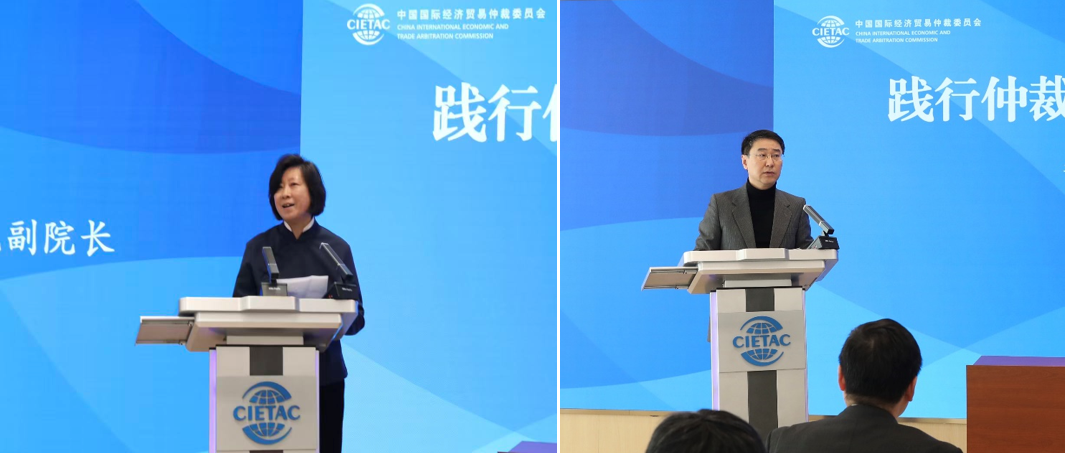
At the conclusion of the seminar, Xie Changqing, Vice President of the Arbitration Court of CIETAC, delivered a closing address. She fully affirmed the effectiveness of the training, commending its authoritative, professional, and highly practical nature. Shi Hong's keynote lecture, rich in both theoretical depth and practical insight, provided authoritative guidance for participants to accurately comprehend the spirit of the new law and grasp key application points, charting a clear course for its implementation. The keynote presentations delivered by directors of relevant CIETAC departments on aligning arbitration rules and key issues in judicial review effectively equipped participants with the essentials for applying the new law, ensuring a smooth transition from theory to practice. She noted that since its establishment in 1956, CIETAC has pioneered modern commercial arbitration practices, contributed core institutional models for the drafting of China's first Arbitration Law, and laid a solid practical foundation for this latest amendment. The new Arbitration Law is not only a statutory framework to be followed but also a new starting point for CIETAC's continued exploration and innovation. Concluding the seminar, Xie Changqing expressed three expectations for arbitrators and institutional staff. First, uphold professional ethics by strictly fulfilling disclosure and withdrawal  obligations, and resolutely guard against cases influenced by personal connections or relationships, thereby reinforcing the foundation of credibility. CIETAC will strengthen dynamic assessments and supervision of arbitrators to ensure the development of a high-caliber arbitrator team. Second, refine professional expertise by flexibly applying international arbitration procedures and innovative tools to enhance competence in handling foreign-related cases, ensuring that awards balance legal principles with industry practices. CIETAC will empower arbitrators through tiered and categorized training, optimized appointment procedures, and enhanced application of online systems and AI. Third, elevate the strategic perspective of case handling by aligning it with national strategies and the development of an international business environment. Arbitrators and institutional staff shall pool professional expertise to drive innovation in arbitration practice and refine legal frameworks. Xie Changqing, Vice President of the Arbitration Court of CIETAC, emphasized that arbitration serves as a vital instrument for coordinating domestic and international rule of law and participating in global governance. She called on all to seize this training opportunity to implement the requirements of the new law, propelling Chinese arbitration to demonstrate its contemporary relevance and China's commitment within the landscape of international and domestic arbitration governance.


(Xie Changqing, Vice President of the Arbitration Court of CIETAC, delivered concluding remarks, and Gu Yan, Vice President of CIETAC Arbitration Court, chaired the semianr.)


As a pivotal preparatory measure for the implementation of the new law, this seminar has solidified the theoretical foundation and strengthened professional safeguards for the smooth enforcement of the newly revised Arbitration Law. It has effectively broadened the vision and sharpened the professional competence of China's arbitration community. As such, this seminar is poised to make significant contributions to advancing China's arbitration sector toward a new stage of high-quality development , accelerating its emergence as a preferred seat for international commercial arbitration, and supporting the country's higher-standard opening up.

{{ article.quickLinkTitle ? article.quickLinkTitle : 'Quick Links' }}
Quick Links