On 9 December, “Disputes and ADR For Contracting Parties Engaged in Belt and Road Initiative Projects” co-hosted by China International Economic and Trade Commission (CIETAC) and Thailand Arbitration Center  (THAC) was successfully held online. The seminar invited Chinese and foreign arbitration legal experts to discuss dispute resolution related to the “Belt and Road Initiative” , help arbitration users in countries and regions along the “Belt and Road” to deepen their understanding of dispute resolution system, and enhance their participation in economic and trade activities.



Wang Chengjie, Vice Chairman and Secretary General of CIETAC, delivered an opening speech on behalf of the host. He pointed out that since the implementation of “Belt and Road Initiative”, the economic and trade exchanges between countries along the route  have been active, which has put forward new requirements for fair, fast and efficient dispute resolution services. In recent years, the number of foreign-related cases accepted by CIETAC and parties involved have been increased  year by year. Among them, the number of cases related to the “Belt and Road Initiative” project have reached more than 1000, the amount in dispute exceeded 50 billion RMB. Therefore, it is of great urgency to actively promote the stable development of the "Belt and Road Initiative" and resolve the conflicts and disputes. Subsequently, Secretary General Wang introduced the characteristics of CIETAC arbitration from six aspects, including the advanced nature of arbitration rules, the professionalism and internationality of arbitrators, the diversity of dispute resolution services, the globalization of the layout, the fairness and efficiency of arbitral awards, and active international communications. He said that CIETAC would continue to cooperate with dispute resolution institutions of various countries including Thailand Arbitration Center, to promote the integration and exchange of arbitration culture and ideas, provide more convenient and efficient dispute resolution services for commercial entities, and promote the construction of "the Belt and Road Initiative" towards high-quality development.


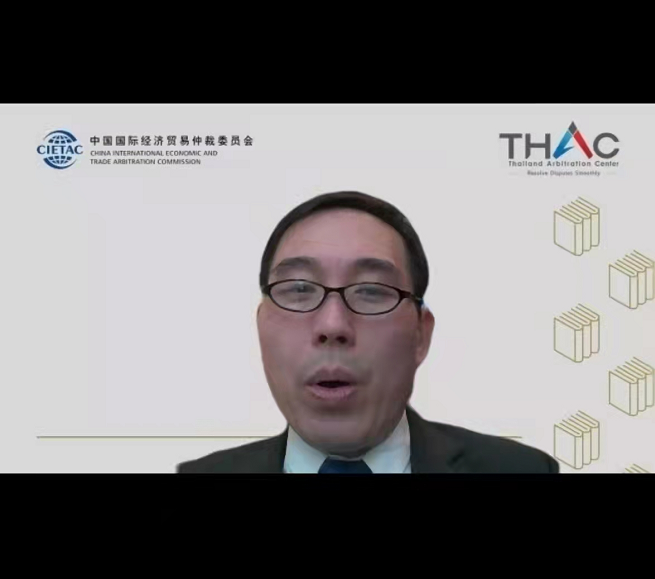
Mr. Pasit Asawawattanaporn, CEO of THAC, delivered speech on behalf of THAC. He said that the “Belt and Road Initiative” has been widely responded in the world. As a universal commercial dispute resolution method, Arbitration will play an increasingly important role in promoting fair settlement of trade and investment disputes and escorting economic and trade exchanges between countries. As one of the five most preferred arbitration institutions in the world, CIETAC has been providing high-quality dispute resolution services to parties all over the world. THAC hopes to continue to share experience with CIETAC in the future to help the construction of the rule of law under the “Belt and Road Initiative”.


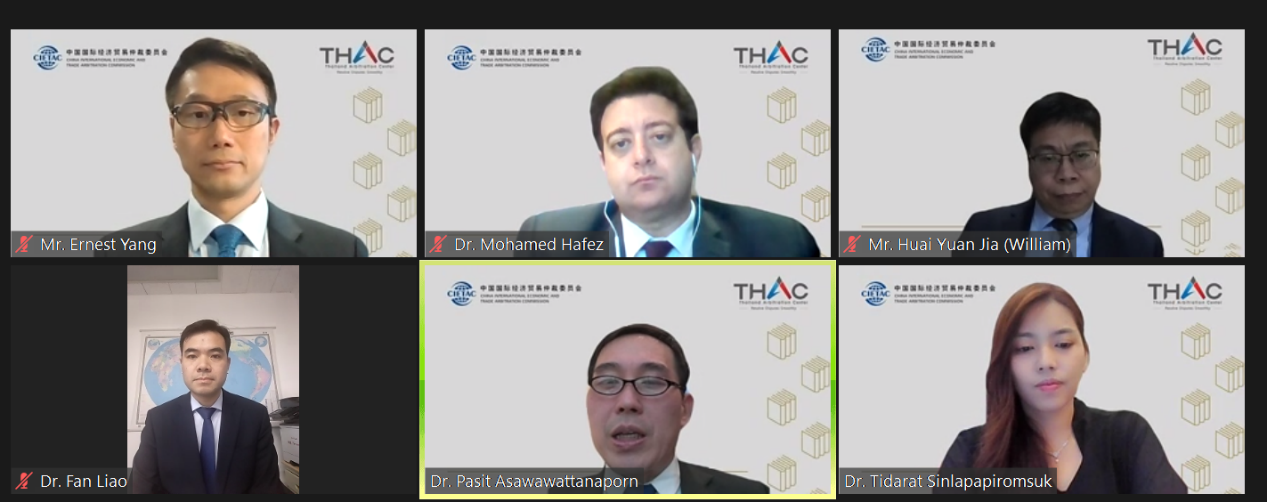
The seminar is hosted by Tidarat Sinlapapiromsuk, Doctor of Chulalongkorn University in Thailand. Lawyer Jia Huaiyuan, an expert in arbitration theory and practice, director of Dubai Office of DeHeng Law Office , Dr. Liao fan, Deputy Director of Bureau of International Cooperation of Chinese Academy of Social Sciences , Dr. Mohamed Hafez, Legal Counsel of Cairo Regional Centre for International Commercial Arbitration , Lawyer Yang Daming, Co-Head of International Arbitration, Asia Pacific of DLA Piper , analyzed and discussed in depth from multiple angles and perspectives on topics including the “Advantage of Dispute Resolution Methods Such As Arbitration and Mediation in Resolving ‘Belt and Road Initiative’ Disputes” and “‘One-Stop’ Dispute Resolution Mechanism”, “The Draft of Dispute Resolution Clauses in ‘Belt and Road Initiative’-Related Contracts”, “The Application of Dispute Board in ‘Belt and Road Initiative’-Related Construction Project Dispute Resolution”, “The Legal Risks in the ‘Belt and Road Initiative’ Investment Process” and “Development of Various Diversified Dispute Resolution Methods”, etc., and answered related questions raised by the attendees.


Audience from China, Singapore, India, Thailand, U.S.A, Malaysia, UK, Zimbabwe and other countries and regions attended the seminar online. Attendees spoke highly of this online seminar, and they all stated that the content shared by each speaker was rich and had great practical reference value and significance.

{{ article.quickLinkTitle ? article.quickLinkTitle : 'Quick Links' }}
Quick Links