2021 China Arbitration Summit and the 2nd Belt and Road Arbitration Institutions Forum (“the Forum”) was successfully held in Beijing on 14 September, 2021. The Forum was co-hosted by China International Economic and Trade Arbitration Committee (CIETAC) and All China Lawyers Association (ACLA), with International Bar Association (IBA) Arbitration Committee as the international partner. Gao Yan, Chairperson of China Council for the Promotion of International Trade (CCPIT), Wang Shengming, Member of the Standing Committee of the National People’s Congress (NPC) and Vice Chairman of the Supervisory and Judicial Affairs Committee of the NPC and Xiong Xuanguo, Vice Minister of the Ministry of Justice (MOJ), attended the opening ceremony and delivered opening remarks. Philippe PINSOLLE, Co-chair of the IBA Arbitration Committee, delivered a pre-recorded speech. Tao Kaiyuan, Vice President of the Supreme People’s Court (SPC), attended the opening ceremony and gave a keynote speech. Lu Pengqi, Vice President of the CCPIT, moderated the opening ceremony.


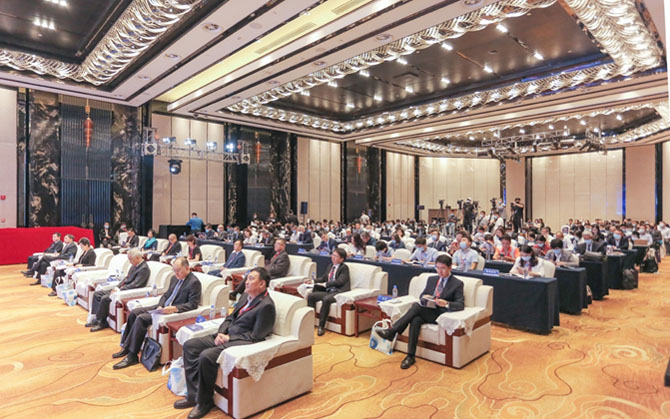
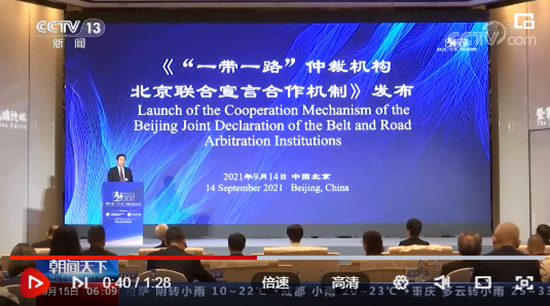
(The Venue of 2021 China Arbitration Summit and the 2nd Belt and Road Arbitration Institutions Forum)


Around 200 representatives from major arbitration institutions, judges, arbitrators, lawyers, scholars, industrial and commercial practitioners at home and abroad attended the Summit on site. China Media Group Mobile  and other media platforms received 2.412 million audience from nearly 40 countries and regions.


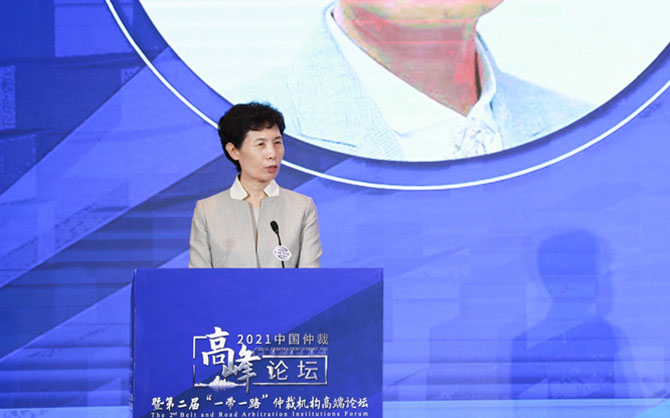
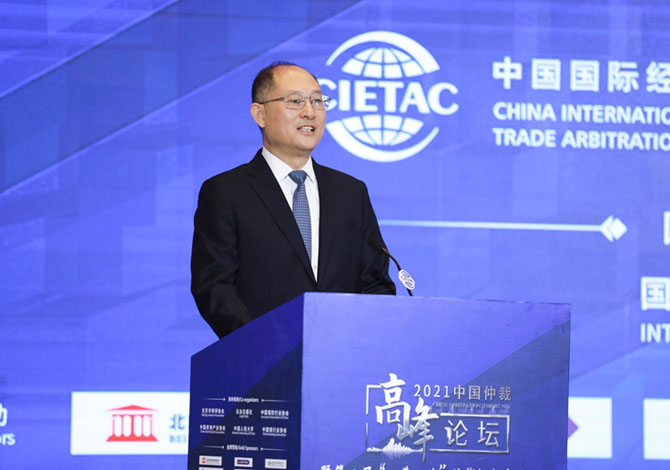
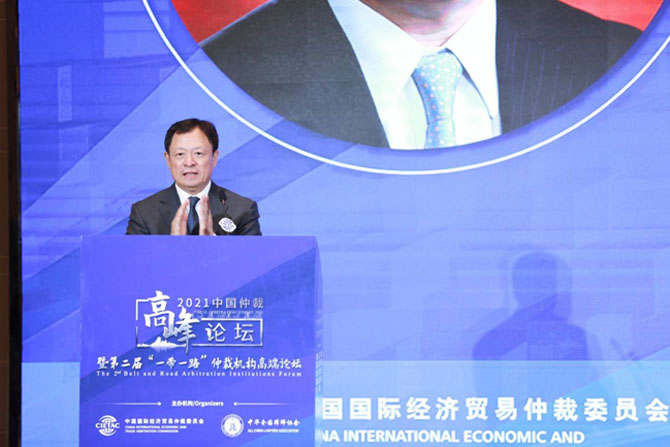
(Gao Yan, Chairperson of the CCPIT, addressing the opening ceremony)


Gao Yan pointed out that as the first-established and most representative standing arbitration institution in China, CIETAC has widely established communications among international arbitration community, deepened cooperation with international organizations and arbitration institutions, continued to promote the application of international conventions, explored on the practice of arbitration, and been diligent in building a new cooperation platform. CIETAC has also led the launch of the Cooperation Mechanism of the Beijing Joint Declaration of the Belt and Road Arbitration Institutions and contributed to the development of international arbitration governance. She further proposed that CIETAC will work with its global counterparts to promote the wider application and high-quality development of international arbitration and will play a more significant role in maintaining international economic and trade order and reforming the global governance. The improvement of arbitration system is imperative to elevate the construction to a new and higher-level open economy, CIETAC shall be active in technological innovation to enhance new driving forces for the development of arbitration service, deepen international cooperation to advance the rule of law in arbitration of the Belt and Road Initiative.


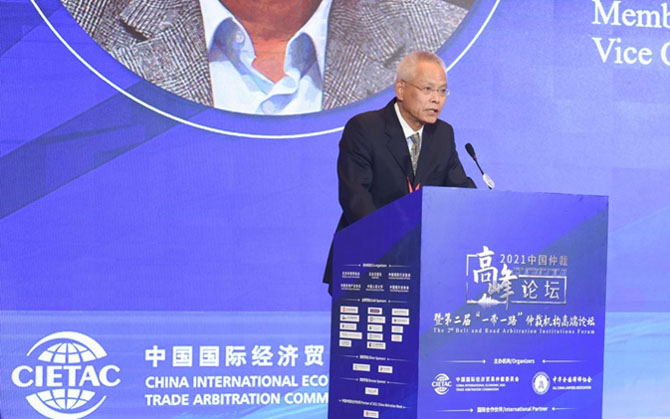
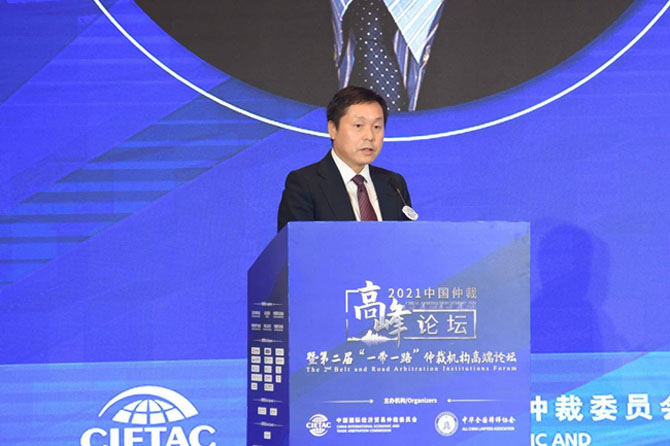
(Wang Shengming, Member of the Standing Committee of the NPC, Vice Chairman of the Supervisory and Judicial Committee of the NPC, addressing the opening ceremony)


Wang Shengming briefly reviewed the history of the development of arbitration in China in his remarks. He noted that since the reform and opening up, arbitration in China has witnessed the remarkable development and attracted worldwide attention. In the new era, the arbitration community shall seize the opportunity and forge ahead. First of all, stay observant. As international, domestic and regional situation all influence the business of arbitration to different extents, close attention shall be paid to the change of the situation in order to react properly. Second, serve the overall interest. The study of law incorporates the study of national development goals and major policy decisions. The national development goals and major policy decisions shall be achieved and implemented through the strict implementation of laws. Third, respect party autonomy. The advancement of arbitration rules, the efficiency and the credibility of arbitration all depends on to what extend the party autonomy is respected. Forth, be open to innovate. Information technologies, such as big data and block chain, shall be fully used to build smart platform and further improve the arbitration system. Fifth, strengthen supervision. The vitality of arbitration lies in its credibility. Internal and external supervision must be tightened.


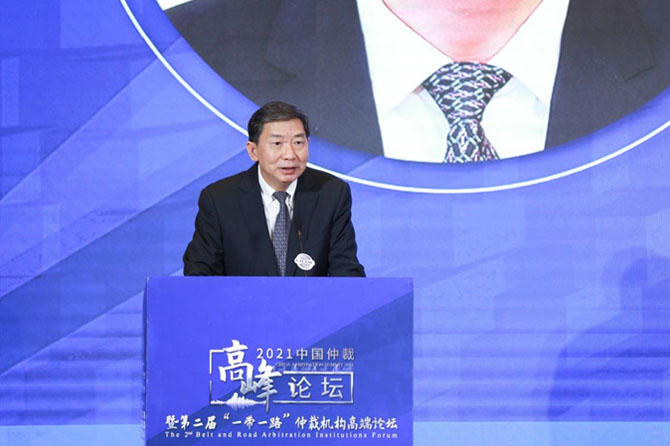
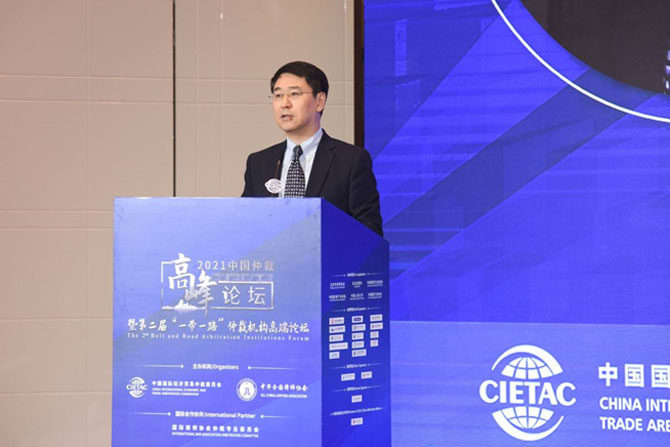
(Xiong Xuanguo, Vice Minister of the MOJ, addressing the opening ceremony)


Xiong Xuanguo indicated that the MOJ has always been proactive to create a fair, impartial, and sustainable market-oriented, legalized, and internationalized business environment, strived to provide high-quality, efficient, and professional legal services and legal protection for international economic and transactions, and has made impressive achievements. Since the implementation of the Arbitration Law in 1995, over 270 arbitration institutions has been established in China, which handled a total of over 4 million cases with the total disputed amount over RMB5 trillion. Parties from over 100 countries and regions were involved. The disputes covered a wide range of industries related to economic and social development. China has become one of the countries where arbitration is often chosen to resolve civil and commercial disputes. Chinese government attaches great importance to international communication and cooperation in arbitration, and strongly supports renowned overseas arbitration institutions to establish offices in the free trade zones of Beijing, Shanghai, and other regions. Arbitration is playing an important role in supporting the all-round opening up and participating in the governance of the global economic and trade business environment. He further proposed three suggestions on improving legal services for foreign-related arbitration. The first is to create the brand image of Chinese arbitration and develop world-class institutions. The second is to innovate the talent training mechanism to facilitate the development of arbitration business. The third is to deepen international communications in arbitration and promote the scope and depth of cooperation.


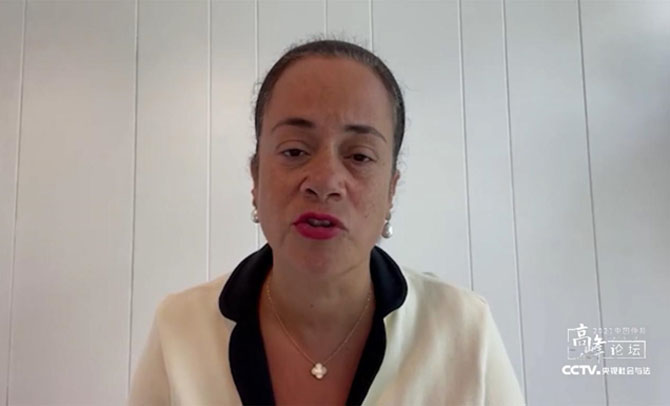
(Philippe PINSOLLE, Co-chair of the IBA Arbitration Committee, delivering a pre-recorded video speech)


Philippe PINSOLLE mentioned that the IBA Arbitration Committee has made great contributions to the coordinated development of international arbitration in the past 50 years. The foundation of international arbitration is international cooperation. The New York Convention and the Washington Convention on investment arbitration, as two concrete pillars of international arbitration, have fully demonstrated the results of international cooperation. Under the impact of COVID-19, arbitration institutions, arbitrators, the parties and their agents shall adapt to the new form and new norm of international arbitration and participate in the proceedings in a more cost-effective and efficient way. CIETAC and the ACLA have made great effort in promoting the development of international arbitration. The IBA Arbitration Committee will made every effort to facilitate international arbitration with the same goal.


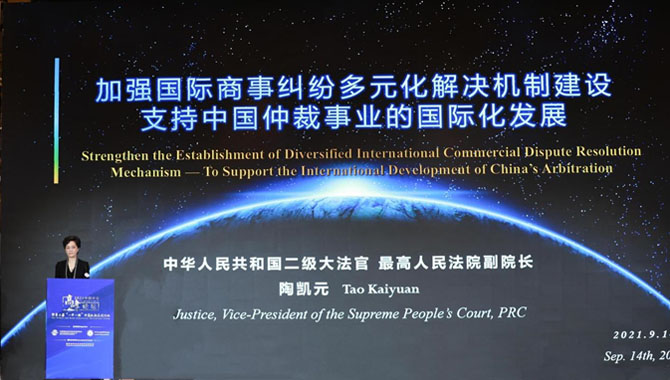
(Tao Kaiyuan, Vice President of the SPC, giving keynote speech)


Tao Kaiyuan indicated that in recent years, people’s courts in China have focused on the establishment of a diversified international commercial disputes resolution mechanism and supported the rule of law, professionalism and internationalization of commercial arbitration. In order to serve the high-level opening-up and promote high-quality development of the Belt and Road Initiative, the SPC set up the International Commercial Court to improve the international commercial dispute settlement mechanism; regulated the judicial review of arbitration and unified the standards for judicial review; supported the innovation of arbitration system and promoted the internationalization of arbitration business in China.


(Lu Pengqi, Vice Chairman of the CCPIT, moderating the opening ceremony)


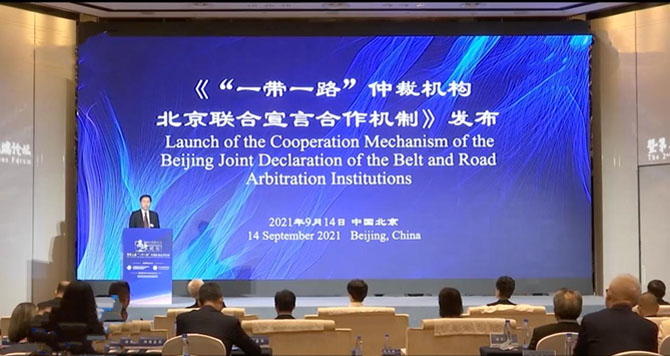
(Wang Chengjie, Vice Chairman and Secretary General of CIETAC, launching the Cooperation Mechanism of the Beijing Joint Declaration of the Belt and Road Arbitration Institutions)


Since CIETAC announced the Beijing Joint Declaration of the Belt and Road Arbitration Institutions (“Beijing Joint Declaration”) together with over 40 domestic and foreign arbitration institutions in 2019, the 2nd Belt and Road Arbitration Institutions Forum (the Forum) was held this time. Wang Chengjie launched the Cooperation Mechanism of the Beijing Joint Declaration of the Belt and Road Arbitration Institutions (the "Cooperation Mechanism") at the Forum, which was signed by 32 foreign arbitration institutions and organizations and 15 domestic arbitration institutions. In his speech titled “the Pursuit of Common Prosperity”, Wang Chengjie pointed out that the Belt and Road Initiative will not exist without a business environment ruled by law, and countries along the Belt and Road should strengthen cooperation on the rule of law. In order to implement the Beijing Joint Declaration and promote the development of the rule of law for the Belt and Road Initiative in an in-depth and practical manner, CIETAC has jointly entered into the Cooperation Mechanism with leading domestic and foreign dispute resolution institutions, in an effort to further enhance the synergy of the arbitration community in different countries and create a favorable legal environment for global economic development. He emphasized that, the Cooperation Mechanism is based on the requirements of the times and reflects the common aspiration and vision of all founding members. CIETAC looks forward to working with its domestic and international counterparts to strengthen cooperation and strive for more achievements, to strengthen technological support and build an information technology cooperation mechanism, to facilitate information sharing and develop a legal system for communication and integration of the Belt and Road Initiative.


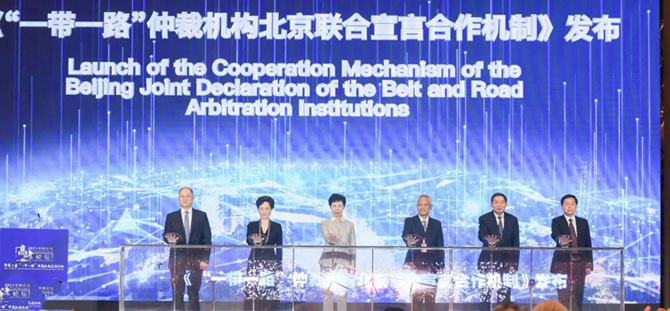
(Chairperson Gao Yan, Vice Chairman Wang Shengming, Vice President Tao Kaiyuan, Vice Minister Xiong Xuanguo, Vice President Lu Pengqi,Secretary General Wang Chengjie jointly launching the Cooperation Mechanism of the Beijing Joint Declaration of the Belt and Road Arbitration Institutions)


The launching ceremony of the Cooperation Mechanism was held at the Forum and received warm applause as congratulations from the audience.

The theme of the Forum is “Where there is a will, there is a way: Cooperation and Development in International Dispute Resolution in the New Era”. Over 20 Chinese and foreign experts participated in the Forum and gave keynote presentations on topics such as “International Cooperation: Building the Belt and Road Legal Community”, “Global Perspective: Adapting International Arbitration to a Changing World” and “China Focus: the Perfection of Arbitration System and the Enhancement of the Credibility of Arbitration”. All participants were actively involved in the communication. The Forum is of great significance to promote the high-quality development of the Belt and Road Initiative, promote the development of arbitration at home and abroad and facilitate international arbitration communication and cooperation.


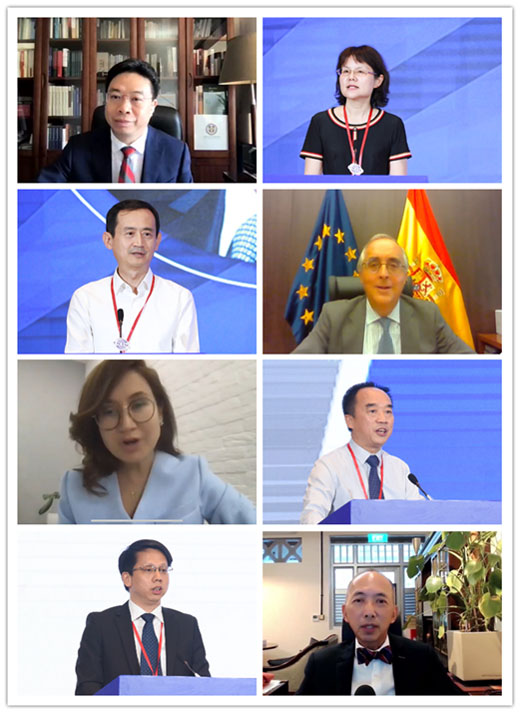
[Session I: “International Cooperation: Building the Belt and Road Legal Community”. From top to the bottom, from left to right, Shan Wenhua, ICSID Conciliator, Dean of School of Law at Xi’an Jiaotong University, Member of the International Commercial Expert Committee of the SPC, Shen Hongyu, Deputy Chief Judge of the Fourth Civil Division of the SPC, Zhang Xuebing, Vice President of the ACLA, Founding Partner of Zhong Lun Law Firm, José Antonio CAíNZOS, President of Madrid International Arbitration Center (MIAC), Diana BAYZAKOVA, Director of Tashkent International Arbitration Centre (TIAC), Wang Shubao, General Counsel of Power Construction Corporation of China, Ltd., Cai Junfeng, General Manager of Legal Affairs Department of the Export-Import Bank of China, Lawrence BOO, Member of Singapore International Arbitration Centre (SIAC) Court of Arbitration.]


In Session I, panelists engaged in a heated discussion on building a community of rule of law for the Belt and Road Initiative. They also referred to cases in practice to analyze how to strengthen judicial communication and mutual assistance between arbitration institutions, enhance the competitiveness of China’s international commercial dispute settlement mechanism, prevent legal risks, and optimize the legalized business environment for the Belt and Road Initiative.


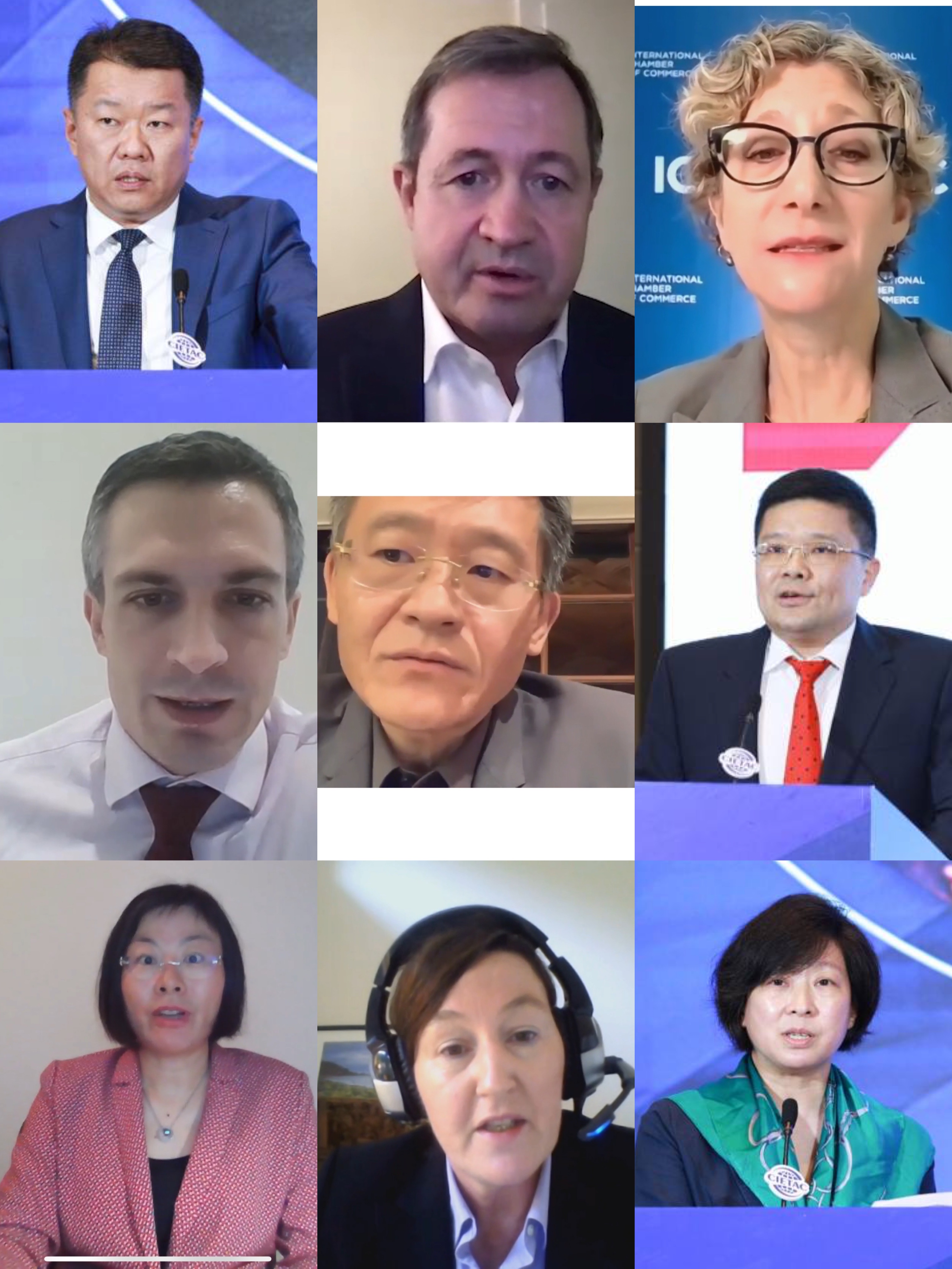
[Session II, “Global Perspective: Adapting International Arbitration to a Changing World”. From top to the bottom, from left to right, Cao Lijun, Co-chair of the Sub-committee on International Commercial Arbitration Case Law of the IBA, Co-head of Dispute Resolution Department, Zhong Lun Law Firm, Philippe PINSOLLE, Co-chair of the IBA Arbitration Committee, Claudia SALOMON, President of the International Court of Arbitration, International Chamber of Commerce (ICC), Emmanuel JACOMY, Partner of Shearman & Sterling, Xin Zhengyu, Director of the Management Committee of TianTong Law Firm, Zhan Hao, Managing Partner of Anjie Law Firm, Liu Yong, General Counsel of COFCO International, Norah GALLAGHER, Deputy Director of the School of International Arbitration, Queen Mary University of London, Xie Changqing, Vice President of CIETAC Arbitration Court.]


In Session II, panelists discussed in depth the cutting-edge and hot issues on international arbitration, such as the development of international arbitration rules, the application of technology, the importance of cyber security and information protection and the improvement of efficiency in the post-epidemic context, providing unique views on the development direction of international arbitration in the new era.


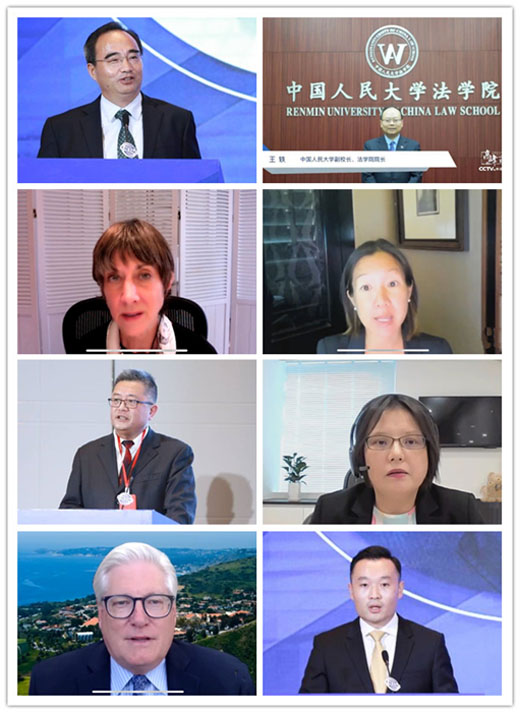
[Session III: China Focus: The Perfection of Arbitration System and the Enhancement of the Credibility of Arbitration. From top to the bottom, from left to right, Huang Jin, President of Chinese Society of International Law, President of China Society of Private International Law, Member of the International Commercial Expert Committee of the SPC, Wang Yi, Vice President of Renmin University of China and Dean of the Law School, Lucy REED, President of International Council for Commercial Arbitration (ICCA), Chiann BAO, Vice Chair of the IBA Arbitration Committee, Liu Jingdong, Director of International Economic Law Department, Institute for International Law of Chinese Academy of Social Sciences, Helena CHEN, Partner of Pinsent Masons LLP,  Thomas STIPANOWICH, William Webster Chair in Dispute Resolution, Leader of the Straus Institute for Dispute Resolution at Pepperdine University and Ji Chaoyi, Head of Dispute Resolution Department, East & Concord Partners Law Firm.]


In Session III, standing from the realities of arbitration development in China and referring to international arbitration experience, the panelists exchanged opinions on the integration between the party autonomy and arbitration rules, the establishment of a diversified dispute resolution mechanism and a “one-stop” platform for dispute resolution and the improvement of credibility of arbitration and put forward suggestions for the revision of the Arbitration Law of People's Republic of China.

The Forum lasted for one day and came to an end with engaging discussion and communication. Closing remarks were delivered by Samaa Haridi, Co-Chair of the IBA Arbitration Committee, Wang Junfeng, President of the ACLA, and Wang Chengjie, Vice Chairman and Secretary General of CIETAC. Gu Yan, Vice President of CIETAC Arbitration Court, moderated the closing ceremony.


(Samaa HARIDI, Co-Chair of IBA Arbitration Committee, addressing the closing ceremony)


Samaa Haridi addressed that the Belt and Road Initiative has brought new opportunities for development and attracted wide attention in the international arbitration community. Arbitration institutions and organizations such as CIETAC have made great effort on it. The revision of the Arbitration Law will be conductive to the integration of Chinese arbitration practice with international commercial practices, further improving arbitration legal system in China and creating an arbitration-friendly legal environment.


(Wang Junfeng, President of the ACLA, addressing the closing ceremony)


Wang Junfeng addressed that the Forum played a positive role and was of practical significance in promoting the stability and improvement of international arbitration. The Cooperation Mechanism is an important measure to explore new modes of cooperation between arbitration institutions along the Belt and Road and to facilitate the construction of the Belt and Road arbitration community. It will contribute to the active cooperation among international arbitration community and the general application of the diversified dispute resolution mechanism around the world.


(Wang Chengjie, Vice Chariman and Secretary General of CIETAC, addressing the closing ceremony)


Wang Chengjie summarized the fruitful results of the Forum. He noted that the Forum has gathered the most authoritative voices from Chinese legislative, judicial and administrative departments, and the attended experts shared the latest, best and most extensive practice in dispute resolution, which was of great practical significance to the development of international arbitration in the post-epidemic era.


(Gu Yan, Vice President of CIETAC Arbitration Court, moderating the closing ceremony)


The Forum came to a successful close with fruitful results.

{{ article.quickLinkTitle ? article.quickLinkTitle : 'Quick Links' }}
Quick Links